What is the rule of regular verbs?
By Emma Johnson •
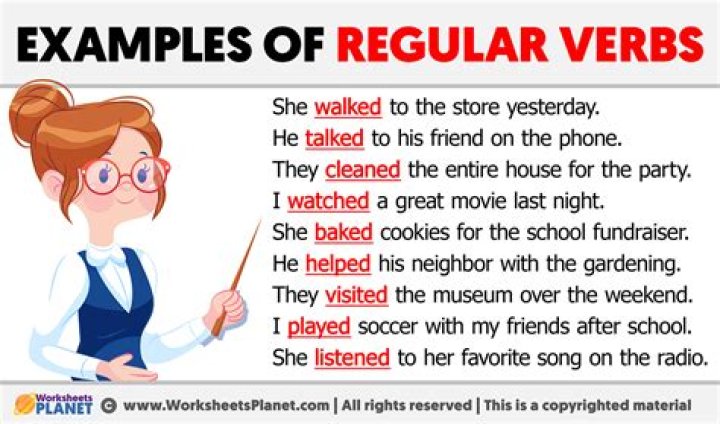
A regular verb is one that conforms to the usual rule for forming its simple past tense and its past participle. In English, the "usual" rule is to add "-ed" or "-d" to the base form of the verb to create the past forms.
What are the rules for regular verbs and irregular verbs?
Regular Verbs are the verbs with usual simple past and past participle forms. Irregular verbs refers to the verbs which have same or different present and past tense forms.What is the formula of regular verb?
Regular verbs are easy. We simply add 'ed' – 'd' if the verb already ends in an 'e' to turn the verb from its base form to the past simple or past participle form. If the verb ends in a 'y' we change the last letter to an 'I' and then add the 'ed'. For example: 'Marry – Married'.What is regular verb and example?
Regular verbs are verbs whose past tense versions are formed by adding an -ed to the end, such as 'walk,' 'climb,' 'decide,' 'describe,' 'drop,' 'want,' 'call,' and 'beg. ' A simple past sentence contains only the past tense verb, as in 'She walked to school.Do irregular verbs have rules?
In English grammar, an irregular verb (pronounced i-REG-u-lur verb) is a verb that does not follow the usual rules for verb forms. Also known as a strong verb. Verbs in English are irregular if they don't have the conventional -ed ending (such as asked or ended) in the past tense and/or past participle forms.Regular Past Tense Verbs | Simple Past Tense Rules, Examples, And Pronunciation Practice
Is say a regular verb?
Irregular verb: To Say.What are 4 irregular verbs?
Some irregular verbs, like let, shut, and spread, never change, whether present or past. Others, like feel and teach, become modified versions of themselves (felt, taught) to form both the past tense and the past participle.How do you teach regular verbs?
Introduce the Past Simple of regular verbsGive an example in Present Simple: I talk to my sister everyday. Lead into past simple: Yesterday, I talked to them. Write this on the board. Give more examples with regular verbs and write each verb in its past form on the board.